
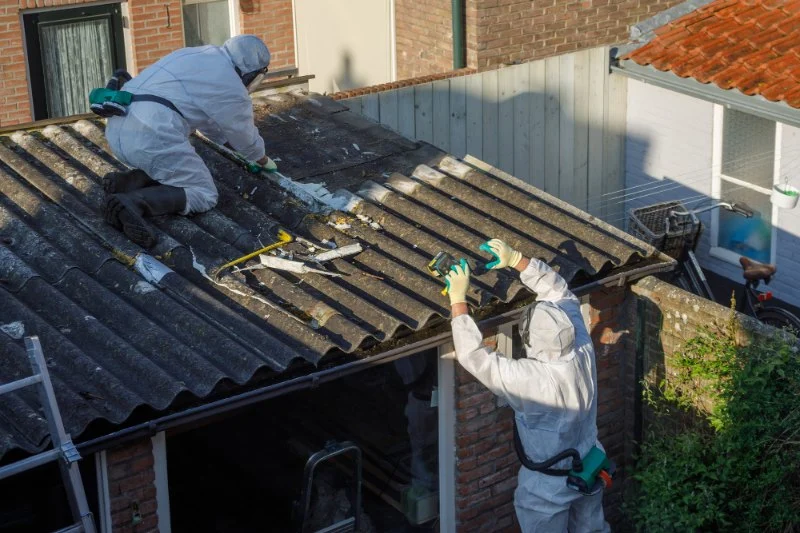
- 1. Understanding the Asbestos Hazard in Roofing
- 2. How Roof Contractors Safely Handle Asbestos and Hazardous Materials
- 3. Protective Measures for Contractors and Homeowners
- 4. Real-Life Examples: Safe Removal of Asbestos in Canada
- 5. Why Choose Pickering Roofing for Safe Roofing Services
1. Understanding the Asbestos Hazard in Roofing
Asbestos is a naturally occurring mineral that was widely used in building materials, including roofing, insulation, and flooring, due to its durability and heat resistance. However, it was discovered that inhaling asbestos fibers can lead to serious health conditions, such as lung cancer, mesothelioma, and asbestosis. In Canada, roofing contractors must be well-equipped to handle asbestos safely, especially when dealing with older homes built before the 1980s, when the use of asbestos was phased out. Asbestos-containing materials (ACMs) are still common in older roofs, making it essential to understand the risks and safety measures associated with handling these hazardous materials.
Roof Doctor / roof doctors
KelownaCentral OkanaganBritish Columbia
715 Evans Ct, Kelowna, BC V1X 6G4, Canada
2. How Roof Contractors Safely Handle Asbestos and Hazardous Materials
Roof contractors dealing with asbestos or other hazardous materials must follow strict safety protocols to ensure the safety of themselves and the homeowners. The following steps are critical in safely managing asbestos during roof removal and installation:
Marlad Roofing & Siding Inc / marlad
BramptonRegional Municipality of PeelOntario
30 Hale Rd Unit 14, Brampton, ON L6W 4N9, Canada
1. Inspection and Identification
Before starting any roofing project, especially in older buildings, contractors perform a thorough inspection to determine whether asbestos is present. If asbestos-containing materials are suspected, contractors may send samples to certified laboratories for testing. Only after confirming the presence of asbestos can contractors proceed with the necessary safety precautions.
2. Containment and Isolation
To prevent the spread of asbestos fibers, the work area is isolated and contained. This involves sealing off the area with plastic sheeting and ensuring proper ventilation. Contractors may also create negative pressure within the work zone to further minimize exposure to airborne fibers. This containment process is crucial in preventing the contamination of other parts of the home or surrounding areas.
3. Safe Removal and Disposal
Once the work area is contained, contractors carefully remove the asbestos-containing materials. Special tools and techniques are used to minimize the disturbance of the material, ensuring that asbestos fibers do not become airborne. The removed asbestos is placed in double-wrapped, sealed bags that are labeled as hazardous waste. These materials are then disposed of at licensed hazardous waste disposal sites, in accordance with local regulations.
4. Post-Removal Cleaning and Decontamination
After the asbestos materials have been removed, the area is thoroughly cleaned and decontaminated. This includes HEPA (High-Efficiency Particulate Air) vacuuming, wiping down surfaces, and ensuring that no asbestos fibers remain. Contractors often use air monitoring to ensure the air quality is safe before the area is reopened.
3. Protective Measures for Contractors and Homeowners
Roof contractors are required to wear personal protective equipment (PPE) when handling hazardous materials like asbestos. This typically includes:
1. Respirators
Contractors wear specialized respirators with P100 filters to protect themselves from inhaling asbestos fibers. These respirators are designed to filter out even the smallest particles.
2. Protective Clothing
Contractors wear disposable coveralls, gloves, and shoe covers to prevent asbestos fibers from contaminating their clothing and skin. This clothing is disposed of properly after the job is completed.
3. Safety Training and Certification
Roof contractors working with asbestos must have proper training and certification. In Canada, contractors need to follow the guidelines set by Occupational Health and Safety (OHS) regulations. They should also be familiar with the procedures for safe asbestos handling and disposal, ensuring compliance with both provincial and federal laws.
4. Real-Life Examples: Safe Removal of Asbestos in Canada
In one case in Vancouver, a homeowner discovered asbestos-containing roofing materials while renovating their 1950s-era home. They hired a certified roofing contractor who followed the proper procedures for asbestos handling, including inspection, containment, safe removal, and disposal. By adhering to these safety measures, the contractor ensured that no asbestos fibers were released into the home, protecting both the workers and the homeowners from potential health risks.
Another example comes from Ontario, where a roofing company was called to replace the roof of a school built in the 1970s. The school had asbestos-containing materials in the old roofing. The roofing company used specialized equipment, followed the correct safety protocols, and completed the job without any safety incidents. The school was able to continue operations safely without exposure to hazardous materials.
5. Why Choose Pickering Roofing for Safe Roofing Services
If you're looking to replace your roof or undertake a roofing project in Canada and are concerned about asbestos or other hazardous materials, Pickering Roofing is here to help. Our certified contractors have extensive experience in handling hazardous materials safely. We follow all safety regulations and ensure that every project is completed without compromising the health and safety of our clients or workers. We use state-of-the-art equipment and materials, ensuring that your home is both safe and secure throughout the process.
 Roof Pro Plus Home Improvements4.0 (5 reviews)
 Ainger Group Roofing and Exteriors4.0 (5 reviews)
 DTH Contracting Inc.4.0 (10 reviews)
 Custom Contracting Eavestrough Repair Hamilton4.0 (11 reviews)
 Pioneer Quality Roofing0.0 (0 reviews)
 Metstar Building Products Inc5.0 (2 reviews)
 How Much Does a New Roof Cost in 2025? Canadian Roofing Price Guide
 Top Signs Your Roof Has a Leak and What to Do About It in Canada
 Can You Install a New Roof Over an Old One in Canada?
 The Top Questions to Ask Before Hiring a Roofer in Canada
 What Are the Most Common Roofing Scams and How to Avoid Them in Canada
 How to Prepare Your Home for a Roofing Project in Canada