
Attic Ventilation Problems: Signs Canadian Homes Show
On this page
Quick answer
Possible attic ventilation problems include frost or condensation on roof sheathing, damp or compressed insulation, mould or rot, rusted fasteners, blocked soffit vents, uneven roof-snow melting, and recurring ice dams. These signs do not prove that more vents are the answer: roof leaks and warm, moist indoor air leaking into the attic must also be investigated before changes are made.
Roof Rescue Ontario Inc. / trudel & sons roofing ltd
Whitchurch-StouffvilleRegional Municipality of YorkOntario
164 Hawthorn Ave, Whitchurch-Stouffville, ON L4A 4Y8, Canada
What attic ventilation does
Attic ventilation is the controlled movement of outdoor air through a vented roof space, normally using lower intake openings and higher exhaust openings. It helps limit summer heat and remove some moisture that reaches the attic.
Ventilation is only one part of the assembly. Natural Resources Canada describes air sealing as the first defence against indoor water vapour reaching the attic and ventilation as a second line of defence. Insulation controls heat flow. Roof coverings and flashing keep exterior water out. Treating one component without diagnosing the others can leave the cause untouched.
XACT Roof & Renovation Ltd. / xact roofing
227 Regent Ave W, Winnipeg, MB R2C 1R3, Canada
Warning signs to look for
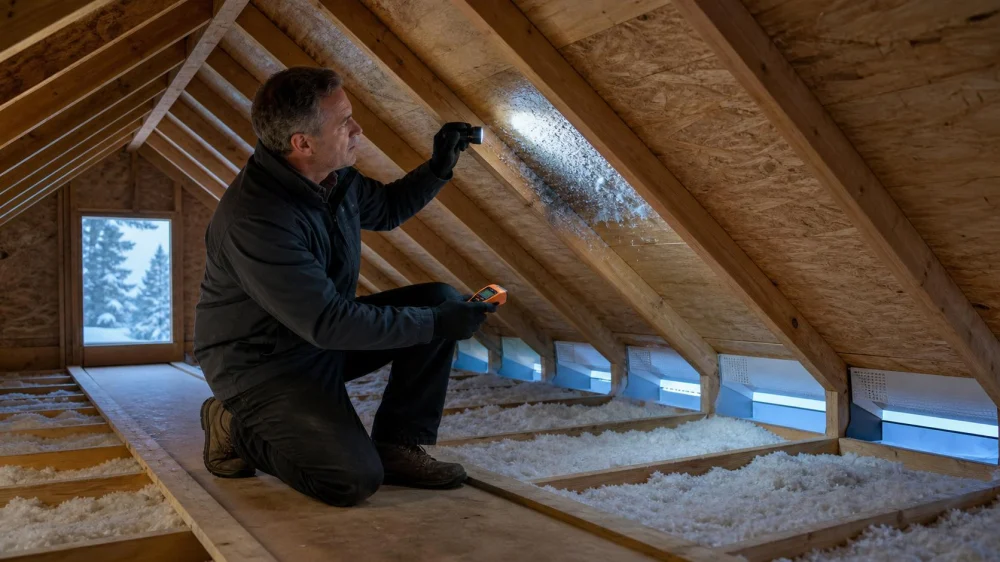
- Frost on nails, sheathing, or rafters during or just after a cold snap.
- Water staining below valleys, chimneys, plumbing vents, or roof penetrations.
- Darkened, damp, matted, or displaced insulation.
- Musty odours, visible mould, soft wood, or rot.
- Bathroom or kitchen exhaust ducts ending in the attic instead of outdoors.
- Soffit vents covered by insulation, debris, paint, nests, or missing baffles.
- Recurring ice at eaves, icicles, or snow melting faster over one heated area.
- Ceiling stains or peeling finishes on the top floor.
One isolated clue is not a complete diagnosis. Record where and when it appears, including weather conditions.
Leak, air leakage, or blocked vent?
Exterior water entry often clusters below damaged roofing, valleys, flashing, skylights, chimneys, or penetrations and may worsen during rain or thaw.
Indoor air leakage commonly occurs around attic hatches, ceiling lights, wiring, plumbing stacks, chimney chases, and poorly sealed exhaust ducts. In cold weather, warm humid air can condense or freeze on cold surfaces.
Airflow restriction can occur when insulation blocks soffit intake or when vent openings are obstructed. However, adding exhaust vents without adequate intake—or installing a powered fan—can draw more house air through ceiling leaks. Diagnose the whole path rather than counting roof caps from the driveway.
A safe homeowner check
- Start from the ground. Photograph eaves, roof-snow patterns, visible vents, and problem areas without climbing onto the roof.
- Check indoor humidity clues. Note window condensation, long bathroom moisture, and fans that do not exhaust effectively.
- Inspect the attic entrance. Look for staining, damaged weather-stripping, or air gaps around the hatch.
- Enter only if access is safe. Use stable flooring or designated walk boards, good lighting, protective clothing, and a respirator appropriate to the hazard.
- Do not disturb insulation. Older materials may contain hazards; avoid stepping between framing members or touching wiring.
- Document, do not dismantle. Photograph frost, staining, ducts, insulation, and visible vent channels for a qualified contractor.
Winter clues and ice dams
Uneven melting can show where heat is reaching the roof deck. Meltwater may travel toward a cold overhang, refreeze, and form an ice dam. The preferred long-term approach for many conventional attics is to limit house heat and moisture entering the attic through appropriate air sealing and insulation, then maintain required ventilation.
Ice dams can also relate to complex roof geometry, sunlight, weather, and local assembly details. Do not use an axe or ice pick on the roof, and do not work below heavy hanging ice. Arrange professional help when ice threatens people, gutters, wiring, or water entry.
What not to do
- Do not assume every moisture problem needs additional vents.
- Do not install a powered attic exhaust fan without assessing intake and ceiling air leakage.
- Do not block soffit intake when adding insulation.
- Do not vent bathrooms, dryers, or kitchens into the attic.
- Do not cover active moisture damage with new insulation.
- Do not climb a snowy, wet, icy, or steep roof to inspect vents.
- Do not disturb suspected asbestos, extensive mould, animal waste, or unsafe electrical components.
What a professional should assess
A qualified roofing or building-envelope professional should trace stains and moisture, inspect roofing and flashing, verify exhaust duct termination, assess ceiling air leakage, review insulation continuity, and determine whether intake and exhaust openings meet the applicable local code and roof design.
Ask for photos and a written explanation separating immediate repairs from optional upgrades. A useful scope states the suspected cause, affected locations, proposed air-sealing or roof work, ventilation products and net free area, insulation protection, permits if applicable, and workmanship or product warranties.
Limitations and urgent triggers
Vent requirements vary by province, municipality, roof slope, attic type, vent screening, and construction. Unvented compact roofs, cathedral ceilings, heritage assemblies, and spray-foam systems require design-specific advice; conventional vent ratios should not be copied blindly.
Leave the attic and seek urgent help for active electrical arcing, a sagging roof deck, major water entry near wiring, a strong gas or combustion odour, extensive contamination, or structural instability. Call emergency services when people are in immediate danger.
Frequently asked questions
Does a hot attic always mean poor ventilation?
No. Roof colour, sun exposure, insulation, air sealing, outdoor temperature, roof design, and venting all affect attic heat. Temperature alone does not identify the cause.
Will adding ridge vents stop attic condensation?
Not necessarily. If moist indoor air is entering through ceiling leaks, extra exhaust can fail to solve the problem and may worsen airflow from the house. Diagnose air leakage, insulation, intake, exhaust, and exterior leaks together.
Should soffit vents be visible from inside the attic?
In a conventional vented attic, a clear channel near the eaves is commonly needed, often protected by baffles. Visibility varies by design. A professional can confirm whether insulation or debris blocks the intended path.
When is the best time to inspect?
A cold snap can reveal frost and condensation; rain or thaw can reveal leakage. Inspection must still wait for safe access conditions.
Sources and evidence notes
The diagnostic framework follows Natural Resources Canada’s Keeping the Heat In: Roofs and attics, including its distinction among roof leaks, indoor air leakage, insulation, ventilation, and ice-dam causes. Local code and an on-site assessment control the final design.
Next steps
Make a dated photo record from safe locations, note whether symptoms follow cold, rain, or thaw, and verify where indoor exhaust fans terminate. Then request an attic and roof assessment that explains the moisture source before recommending vents, insulation, or roof repairs.


 Christensen & McLean Roofing3.0 (13 reviews)
 Perfect Choice Roofing & Eavestrough5.0 (66 reviews)
 Building Products Okanagan0.0 (0 reviews)
 M & D General Contracting Ltd5.0 (6 reviews)
 Green Roofing Solutions5.0 (12 reviews)
 Next Roofing Solution Ltd.5.0 (1 reviews)
 How Much Does a New Roof Cost in 2025? Canadian Roofing Price Guide
 Top Signs Your Roof Has a Leak and What to Do About It in Canada
 Can You Install a New Roof Over an Old One in Canada?
 The Top Questions to Ask Before Hiring a Roofer in Canada
 What Are the Most Common Roofing Scams and How to Avoid Them in Canada
 How to Prepare Your Home for a Roofing Project in Canada