
Curling Roof Shingles: What Canadian Homeowners Should Know
On this page
- Quick answer
- What curling shingles look like
- Why asphalt shingles curl
- Safe ground-level inspection checklist
- Clues inside the home and attic
- How professionals evaluate repair or replacement
- When curling needs prompt attention
- Limitations and evidence notes
- Frequently asked questions
- Conclusion and next steps
Quick answer
Curling shingles have edges or centres that lift away from the roof plane. A few affected tabs may point to local damage or installation issues; widespread curling can indicate ageing, heat, moisture, material deterioration, or system-level conditions. Inspect only from the ground or a safe window, photograph the pattern, check for interior moisture, and hire a qualified roofer to assess the roof surface, deck, ventilation, and remaining serviceability.
Toitures Garant et Frères Inc / toiture garant
LévisChaudière-AppalachesQuébec
6615 Rue Alfred-Pellan, Lévis, QC G6V 9S9, Canada
What curling shingles look like
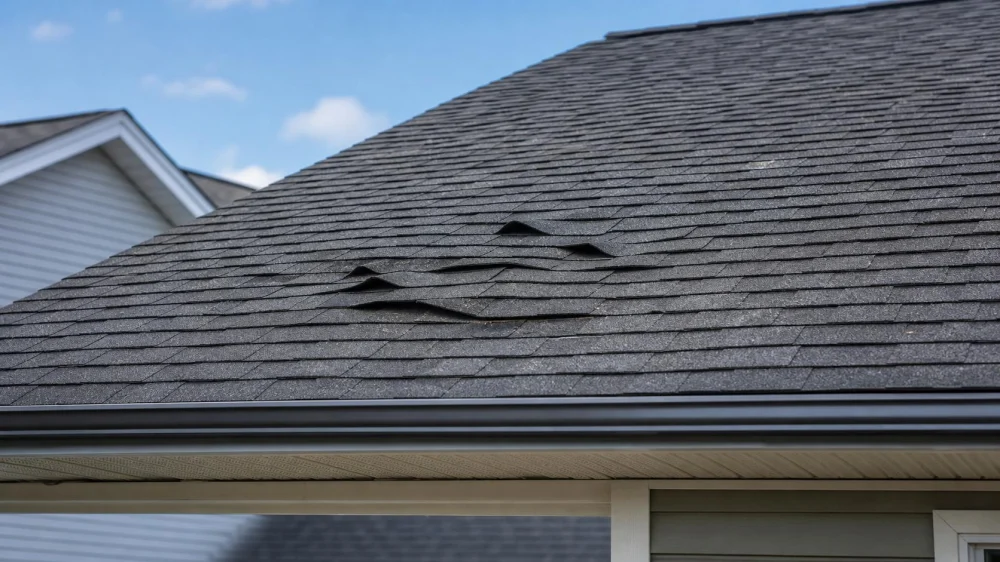
Shingle curling is a visible deformation in which part of an asphalt shingle no longer lies flat. People often use “curling” for several patterns:
- Cupping: The shingle centre appears lower while edges turn upward.
- Clawing: The centre rises or arches while corners or edges turn downward.
- Lifted tabs or corners: One area sits up because of wind, fastening, sealing, debris, or local damage.
- Wavy courses: Larger roof sections appear uneven, which may involve the underlayment, deck, installation, or viewing angle rather than individual curl alone.
These descriptions help communicate what you see; they do not diagnose the cause. Sun angle, frost, snow, and camera distortion can exaggerate the appearance.
Lansard Bros Roofing Ltd / lansard roofing
50 Don Valley Pkwy, Sunnyside, MB R5R 0C9, Canada
Why asphalt shingles curl
- Ageing and weather exposure: Repeated heat, cold, sunlight, rain, snow, and freeze-thaw cycles can change asphalt and reinforcement over time.
- Heat and moisture conditions: Roof-system temperature and moisture may be affected by ventilation, insulation, air leakage, occupancy, and climate. Curling alone cannot prove an attic-ventilation fault.
- Installation details: Incorrect fastener position, overdriven or underdriven nails, misalignment, inadequate sealing, poor substrate preparation, or unsuitable installation conditions can contribute.
- Roof-deck movement: Uneven, wet, damaged, or moving sheathing can create patterns that look like shingle deformation.
- Layering over an existing roof: An overlay may reflect irregularities or heat differently. Whether overlays are permitted and suitable depends on local rules and the assembly.
- Wind or mechanical damage: Lift can break seals and bend corners. Foot traffic, tools, branches, and snow-removal equipment can also damage tabs.
- Material issue: Product defects are possible but should not be assumed. Product identification, installation records, exposure, and manufacturer assessment may be needed.
More than one factor can be present. A roof can be old and also have local fastening or moisture problems.
Safe ground-level inspection checklist
- Choose safe conditions. Avoid lightning, wind, ice, active snowfall, and falling debris.
- Use distance and zoom. View each slope from public or private ground where you are permitted to stand. Binoculars or a camera can help.
- Map the pattern. Note whether curling is isolated, in straight courses, concentrated on one slope, near edges, around penetrations, or widespread.
- Compare exposure. Record which roof direction and which areas receive heavy sun, shade, snow accumulation, or runoff.
- Look for related signs. Missing tabs, exposed fasteners, cracked shingles, granules at downspout outlets, lifted flashing, sagging, and displaced ridge material matter.
- Check after weather events. Photograph changes after wind, freeze-thaw, or snowmelt from the same safe position.
- Find records. Gather invoices, permits, product names, warranty documents, previous inspection reports, and dated photos.
Do not climb onto the roof, press shingles flat, apply sealant, drive nails, or lift tabs. Curling material may be brittle, and walking can cause falls or additional damage.
Clues inside the home and attic
Check finished rooms for water stains, damp odour, peeling paint, swollen trim, dripping, and changes after rain or snowmelt. Note the location and date. Keep away from a bulging ceiling and wet electrical fixtures.
Only enter an attic if there is a safe permanent access, stable walking surface, adequate lighting, and no signs of structural, electrical, mould, insulation, animal, or air-quality hazards. Do not step between framing members or compress insulation.
From a safe access point, visible clues may include:
- Darkened or wet sheathing
- Frost or condensation
- Rusting fasteners
- Daylight at unintended openings
- Disconnected exhaust ducts
- Blocked ventilation paths
These signs need professional interpretation. Daylight may be intentional at vents, and staining may be old. Do not disturb suspected mould, asbestos-containing material, vermiculite insulation, animal waste, or damaged wiring.
How professionals evaluate repair or replacement
A qualified roofer should identify the product and roof assembly, inspect shingle condition and seals, verify fastening and flashing details where accessible, check the deck, review ventilation and moisture conditions, and assess whether matching materials are available.
A localized repair may be reasonable when:
- Damage is limited and the surrounding roof remains serviceable.
- The underlying deck and related details are sound.
- Compatible replacement shingles can be integrated properly.
- The cause can be corrected rather than merely covered.
Broader replacement may be considered when curling is widespread, shingles are brittle or losing integrity, many repairs would be needed, leaks or deck damage exist, or the roof cannot be repaired reliably. The decision should include roof condition, assembly, climate, code requirements, warranty, access, and total scope—not appearance or age alone.
Request photos and a written explanation of the observed pattern, proposed work, excluded work, ventilation or deck findings, materials, disposal, warranty, permits, and how unexpected damage will be handled.
When curling needs prompt attention
Arrange prompt assessment when curling appears suddenly, follows high wind, is accompanied by missing or flapping tabs, exposes underlayment, occurs around active leaks, or appears above sagging roof areas.
Seek urgent help for active interior water near electricity, a rapidly bulging ceiling, falling roof material, structural movement, or a large area lifted by wind. Keep people away from the hazard zone and follow emergency instructions.
Even without a leak, widespread deformation deserves timely review. Waiting for visible indoor water can allow hidden sheathing, insulation, and finish damage to progress.
Limitations and evidence notes
This article reflects common asphalt-shingle assessment practice for Canadian homes. It cannot identify a product defect, ventilation imbalance, installation error, deck problem, or remaining service life from photographs alone. Manufacturer instructions for the specific shingle and a site inspection are stronger evidence.
Roofing, ventilation, insulation, permitting, and contractor requirements vary across Canada by province, municipality, building type, and project scope. Warranty notice and repair procedures also differ. Preserve records and avoid unauthorized work that could affect a claim.
Frequently asked questions
Do curling shingles always mean the roof needs replacement?
No. A small local area may be repairable, while widespread brittle curling can support replacement. A roofer must inspect the surrounding shingles, deck, installation, and cause.
Can I glue curled shingles flat?
Do not apply generic adhesive or sealant. It may trap moisture, damage materials, hide the cause, and conflict with manufacturer instructions. Have a professional identify the appropriate repair.
Does attic ventilation cause all shingle curling?
No. Heat and moisture conditions can contribute, but age, installation, materials, wind, deck movement, and multiple combined factors are also possible. Ventilation must be assessed as a system.
Can cold Canadian winters curl shingles?
Freeze-thaw, snow, ice, and cold affect roofs, but weather alone does not establish the cause. Product suitability, installation, attic conditions, sun exposure, and age all matter.
Should I make a warranty claim?
Review the product and workmanship documents, photograph the pattern, and contact the responsible installer or manufacturer using the required process. Do not assume coverage until the cause and terms are evaluated.
Conclusion and next steps
Photograph curling patterns from safe ground, compare roof slopes, check for interior moisture, and gather installation and warranty records. Do not walk on brittle shingles or press them flat. A written professional assessment should explain whether the issue is local or widespread, identify contributing conditions, and connect the proposed repair or replacement to the actual roof system.

 Nor Star Aluminum & Vinyl Products4.0 (42 reviews)
 Water Tight Roofing & Masonry5.0 (10 reviews)
 JOHNSON ROOFING AND REPAIR4.0 (4 reviews)
 United Roofing3.0 (15 reviews)
 Les Entreprises B&C S.E.N.C0.0 (0 reviews)
 Dillon Bros. Roofing4.0 (11 reviews)
 How Much Does a New Roof Cost in 2025? Canadian Roofing Price Guide
 Top Signs Your Roof Has a Leak and What to Do About It in Canada
 Can You Install a New Roof Over an Old One in Canada?
 The Top Questions to Ask Before Hiring a Roofer in Canada
 What Are the Most Common Roofing Scams and How to Avoid Them in Canada
 How to Prepare Your Home for a Roofing Project in Canada