
Roof Repairs With Solar Panels: Coordinate the Work First
Table of contents
Quick answer
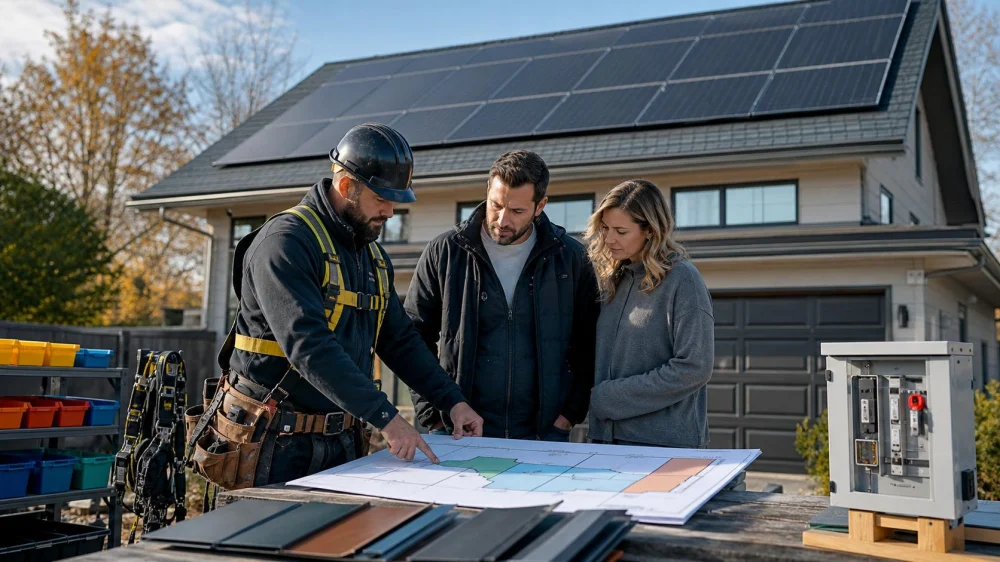
Before repairing or replacing a roof with solar panels, coordinate a qualified roofer, licensed electrical or solar professional, and any structural or warranty contacts. Do not let unqualified workers disconnect, lift, or store modules. Document the roof, racking, wiring, permits, production, and leak location; define who removes and reinstalls each component; and obtain written responsibility for weatherproofing, testing, warranties, schedule, and final inspection.
Toiture Royale Expert Inc. / toiture royale expert
LévisChaudière-AppalachesQuébec
7921 Rue de l'Orge, Lévis, QC G6Y 0G1, Canada
Why coordination matters
A rooftop photovoltaic system combines roofing, structural attachments, electrical equipment, drainage, and weatherproofing. Natural Resources Canada notes that mounting points can concentrate loads and create potential moisture entry, while ballasted systems can affect drainage or abrade a membrane if not properly designed.
Roofing workers also face fall hazards, and solar equipment adds electrical hazards. Panels can produce electricity when exposed to light even if the building’s main power is switched off. Homeowners should stay off the roof and use qualified professionals who understand both work scopes.
Ck Roofing Solutions / ck roofing solutions
MarkhamRegional Municipality of YorkOntario
8 Hikers Ln, Markham, ON L6B 0K3, Canada
Gather system and roof records
- Roof type, age, installer, warranty, and previous repairs
- Solar installer, owner, lender or lease provider, and maintenance contact
- Module, inverter, optimizer, racking, and attachment details
- Electrical single-line diagram and shutdown instructions
- Permits, inspections, utility interconnection, and commissioning report
- Roof and solar warranty terms, including removal and reinstallation
- Production baseline and recent monitoring alerts
- Photos of the array, penetrations, flashing, attic, ceilings, and leak signs
If the system is leased or financed, the owner may need approval before anyone touches it. Do not assume the roofing contract grants that authority.
Plan inspections
Start with safe ground-level and interior observations. Note stains, moisture, timing, and weather. A qualified roofer can inspect roof covering, flashing, drainage, underlayment, sheathing, and the relationship to racking. A solar professional can inspect modules, conductors, connectors, grounding or bonding, rapid-shutdown equipment, and production data.
If attachment, snow load, rot, or structural movement is in question, involve an engineer or other qualified design professional. NRCan recommends integrated design discussion among the builder, PV consultant, structural engineer, and authority having jurisdiction when finalising attachment methods.
Define the work scope
- Mark which roof areas and solar components are affected.
- State whether modules, rails, flashings, or mounts must be removed.
- Identify who has authority and qualifications for electrical isolation.
- Specify temporary weather protection and who monitors it.
- Define storage, security, labeling, and damage responsibility for removed equipment.
- Describe new flashing, roofing, attachment, sealing, and drainage details.
- Set inspection and approval points before covering work.
- Define recommissioning, monitoring checks, cleanup, and closeout documents.
A low roof quote may omit solar removal, electrician time, replacement fasteners, permits, storage, or monitoring support. Compare complete scopes, not only totals.
Check warranties and contracts
Read the roof, module, inverter, racking, workmanship, and lease documents. Ask in writing:
- Who may remove and reinstall equipment without affecting coverage?
- Are new fasteners, seals, or flashings required?
- Who covers labour, shipping, crane, storage, and lost production?
- Does roof work require notice, photos, or inspection?
- Which contractor warrants the final watertight interface?
- How are pre-existing damage and later leaks allocated?
A warranty is not the same as insurance and may exclude labour or consequential damage. Ask providers to identify exclusions before work begins.
Schedule removal and reinstall
Choose a weather window with contingency time. Confirm that roofing materials, solar hardware, permits, fall protection, lifting equipment, and qualified crews will be ready. Removed modules should be individually identified, protected from impact and moisture, and stored securely according to manufacturer instructions.
Do not leave an opened roof waiting for another trade because the handoff was vague. Use a written sequence: safe electrical isolation, module and racking work, roof repair, inspected weatherproofing, reinstallation, electrical testing, utility or authority steps if required, and recommissioning.
Verify the completed work
- Roof covering, flashing, penetrations, and drainage are complete
- Racking and attachments match the approved design
- Conductors are supported, protected, and routed correctly
- Modules are undamaged and securely installed
- Required electrical and building inspections are closed
- System starts and monitoring returns to an expected baseline
- Attic and ceilings show no new moisture after suitable weather
- Photos, test results, invoices, permits, and warranties are delivered
Production varies with season, weather, snow, shade, and temperature. Compare equivalent conditions and have the solar provider interpret unexpected performance.
Limits and emergencies
This guide cannot approve a roof, electrical system, structure, or contractor. Requirements vary by province, territory, municipality, utility, system ownership, and product. Keep away from damaged solar wiring, broken modules, roof edges, and wet electrical equipment. Call emergency services for fire, electrical arcing, structural collapse, severe storm damage, or immediate danger. Use qualified professionals for isolation and repair.
Frequently asked questions
Can the roofer remove the panels?
Only if authorised, qualified, and accepted by the system owner, product documents, insurer, and applicable rules. Many projects need a solar or electrical professional.
Must every panel come off for a small leak?
Not always. Location, access, attachment, damage, and repair method determine scope. Get coordinated inspection.
Should I replace an older roof before installing solar?
Assess remaining roof life and removal cost before installation. Re-roofing soon afterward can add substantial work.
Who guarantees the roof will not leak?
Ask contracts to state responsibility for roofing, attachments, flashing, and the final interface. Do not rely on an oral promise.
Official Canadian sources
Natural Resources Canada’s Planning and Decision Guide for Solar PV Systems covers structural loads, attachment, moisture, drainage, and integrated design. CCOHS provides current residential roofing safety guidance. Use provincial or territorial codes, electrical rules, permits, and manufacturer instructions for the project.
Next steps
Collect the roof and solar records, photograph current conditions from safe locations, and ask a qualified roofer and solar professional for one coordinated written scope. Do not schedule opening the roof until handoffs, weather protection, and recommissioning are assigned.

 Custom Contracting Roofing & Eavestrough Repair Kitchener4.0 (14 reviews)
 Jads roofing5.0 (23 reviews)
 Maintenance brothers5.0 (10 reviews)
 Keyline Roofing5.0 (11 reviews)
 Supreme roofing & construction5.0 (4 reviews)
 Enviro-Green Moss Removal & Roof Cleaning4.0 (7 reviews)
 How Much Does a New Roof Cost in 2025? Canadian Roofing Price Guide
 Top Signs Your Roof Has a Leak and What to Do About It in Canada
 Can You Install a New Roof Over an Old One in Canada?
 The Top Questions to Ask Before Hiring a Roofer in Canada
 What Are the Most Common Roofing Scams and How to Avoid Them in Canada
 How to Prepare Your Home for a Roofing Project in Canada