
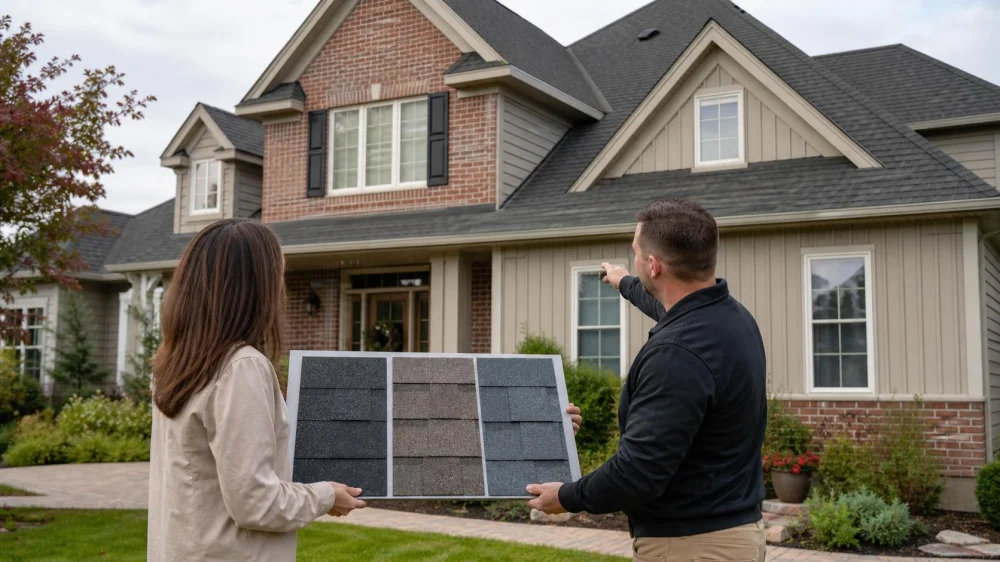
Roof Shingle Colour and Profile: Compare Samples at Home
On this page
- Quick answer
- Judge the roof as part of the whole house
- View samples in changing light
- Compare undertones, not just colour names
- Understand shingle profile and shadow lines
- Move from a small chip to a larger sample
- Check neighbourhood and property rules
- Keep appearance separate from performance
- Plan for batch and natural-looking variation
- Document the final product decision
- Frequently asked questions
- Conclusion and next steps
Quick answer
Compare roof shingles outdoors against the home’s brick, siding, stone, trim, and permanent features. View a large sample from the street in sun, shade, and overcast light, because colour names and online images can mislead. Consider the shingle’s profile and shadow pattern as well as hue. Before ordering, verify community rules, product availability, system compatibility, warranty terms, and the exact manufacturer, line, colour, and code in writing.
This guide uses Canadian spelling and is intended for homeowners comparing appearance. A qualified roofing professional should confirm whether a product suits the roof design, local requirements, climate exposure, and complete roofing system.
Custom Contracting Burlington Roofing & Eavestrough Repair Burlington / eavestrough burlington
BurlingtonRegional Municipality of HaltonOntario
687 Waterloo St, Burlington, ON L7R 2S9, Canada
Judge the roof as part of the whole house
The roof can occupy a large part of the view from the street. Compare shingles with materials that are unlikely to change soon: brick, stone, siding, stucco, window frames, soffits, fascia, gutters, and garage doors. Landscaping and neighbouring roofs also influence the overall impression.
If trim or siding will be repainted, choose those colours together with the roof rather than in isolation. Photograph the full elevation from normal viewing distance, but use the photograph as a memory aid—not a perfect colour reference.
Flynn Canada Ltd. - Toronto / flynn mississauga
MississaugaRegional Municipality of PeelOntario
6435 Northwest Dr, Mississauga, ON L4V 1X1, Canada
View samples in changing light
Direct sun can reveal warm highlights, shade can emphasize cool undertones, and overcast skies can flatten contrast. Place the sample where it receives roughly the same orientation and light as the roof, then view it in the morning, afternoon, and early evening.
Do not climb onto the roof. Secure a sample at ground level against an exterior surface or ask the contractor for a safe display board. Screens, printed brochures, and showroom lighting cannot reproduce outdoor appearance exactly.
Compare undertones, not just colour names
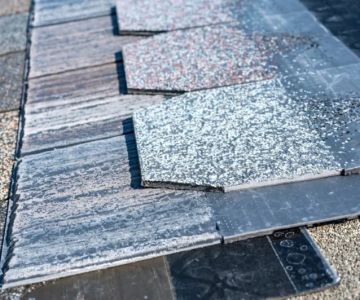
A product sold as grey may lean blue, green, brown, or purple. Brown can contain red, gold, grey, or charcoal granules. Black may be uniform or blended with lighter tones. These undertones become more visible next to brick mortar, stone, or painted trim.
Use a simple comparison: place two or three finalists beside the permanent material and remove the one that makes an unwanted undertone obvious. Avoid choosing from a long row of samples at once, which makes subtle differences harder to judge.
Understand shingle profile and shadow lines
Shingle profile refers to the visible pattern, cut, layering, and dimensional depth after installation. A uniform tab pattern creates a regular rhythm, while laminated or architectural products can produce deeper shadow lines and more variation.
Profile affects how busy or quiet the roof looks. A highly varied shingle may compete with complex brick or stone; a more even product may calm the elevation. On a simple exterior, moderate texture can add depth. Ask to see an installed field, not only one loose shingle.
Move from a small chip to a larger sample
A small swatch may show only part of a blended colour. Request a full shingle, multi-shingle board, or an address where the same current product is installed and visible from public space. Never enter private property or photograph residents without permission.
Stand back to the distance at which the roof will normally be viewed. Fine granules merge into a broader colour from the street, and the profile becomes more important than individual specks.
Check neighbourhood and property rules
Before paying a deposit, check applicable municipal, condominium, heritage, architectural-control, insurance, and neighbourhood requirements. A permit rule may focus on construction rather than colour, while a private or community rule may restrict appearance.
Ask which approval must be written, who submits it, and whether the exact product is named. Do not rely on a neighbour’s past project as proof that the same choice is currently allowed.
Keep appearance separate from performance
Colour and profile are only part of the decision. Product construction, wind classification, impact options, fire classification, installation requirements, underlayment, ventilation, flashing, slope limits, and warranty conditions matter independently.
Do not assume a dark shingle alone causes an attic problem or a light shingle alone solves one. Roof assembly, insulation, air sealing, ventilation, orientation, and climate all affect performance. Ask the contractor to explain the complete system and cite the product documentation.
Plan for batch and natural-looking variation
Blended shingles are designed to vary, and actual production can differ somewhat from a display board or older installation. Ask the supplier how colour lots are managed and how installers mix bundles to avoid unintended patches or stripes.
Confirm what degree of variation is expected and what the manufacturer considers a product issue. If a delivered bundle appears inconsistent, pause installation and raise the concern before a large roof area is completed.
Document the final product decision
The contract or final selection form should state:
- manufacturer and exact product line;
- colour name and product code;
- shingle style or profile;
- approved accessory colours for ridge caps, vents, flashing, and metal;
- availability and substitution policy;
- warranty level and registration responsibility;
- required community or property approval.
Do not accept a substitute based only on a similar colour name. Review a physical sample and updated documents first.
Frequently asked questions
Should the roof match the brick exactly?
Not necessarily. Coordinating undertones and contrast is usually more practical than an exact match. View the whole elevation from the street.
Do dark shingles make a house look smaller?
They can create stronger visual weight, but roof pitch, house proportions, trim, and surroundings also affect perception. Test a large sample.
Can I trust a manufacturer’s website colour?
Use it to narrow choices, not as final proof. Display calibration, photography, lighting, and production variation affect colour.
What if my chosen colour is unavailable?
Ask for a new physical sample, product documents, price, schedule, and written change order before approving a substitute.
Conclusion and next steps
Shortlist a few shingles that coordinate with the home’s permanent materials, then compare large physical samples outdoors from normal viewing distance in several light conditions. Evaluate profile and variation as well as colour. Verify rules, product-system suitability, availability, and warranty details, and record the exact approved selection before materials are ordered.

 Econo-Toit 20004.0 (22 reviews)
 Kingsley Roofing3.0 (2 reviews)
 Wisdom Roofing5.0 (3 reviews)
 Onyx Exteriors Ltd5.0 (1 reviews)
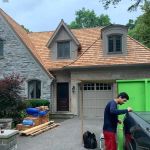 Emerald Cedar Contracting Etobicoke5.0 (5 reviews)
 Flynn Canada Ltd. - Ottawa4.0 (18 reviews)
 How Much Does a New Roof Cost in 2025? Canadian Roofing Price Guide
 Top Signs Your Roof Has a Leak and What to Do About It in Canada
 Can You Install a New Roof Over an Old One in Canada?
 The Top Questions to Ask Before Hiring a Roofer in Canada
 What Are the Most Common Roofing Scams and How to Avoid Them in Canada
 How to Prepare Your Home for a Roofing Project in Canada