
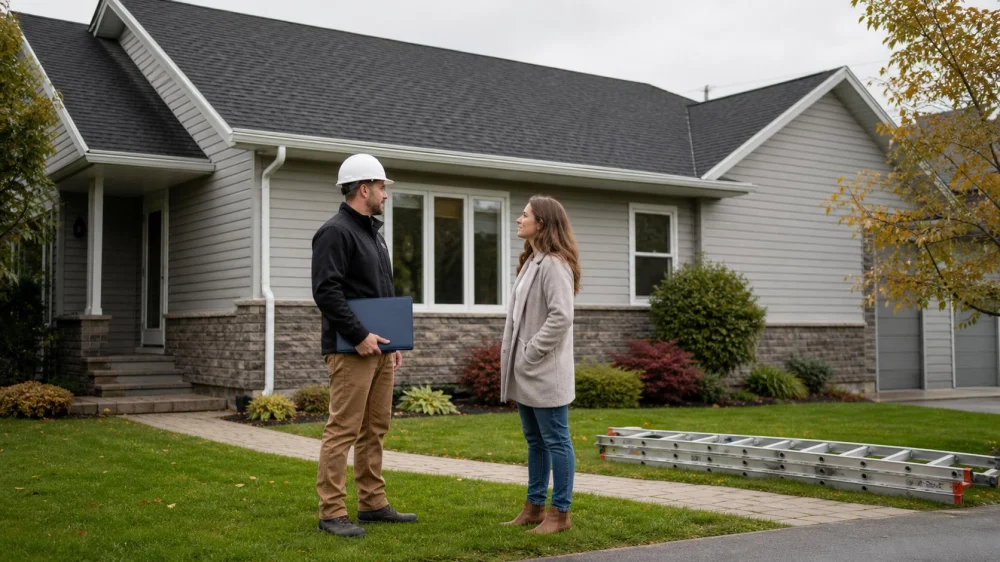
Roofing Contractor Insurance: Verify Coverage Before Work
On this page
Quick answer
Before roofing work starts, confirm the contractor's legal identity, current commercial liability coverage, and required worker protection through documents and the appropriate provincial source. Check that names, policy dates, work type, and project location align, then put responsibility for subcontractors, damage, changes, and incident reporting in the written contract. Insurance is one check, not proof of workmanship.
What contractor insurance does and does not show
Commercial liability insurance may respond to certain third-party injury or property-damage claims, while provincial worker-protection systems address workplace injuries under their own rules. Neither one confirms roofing skill, licensing, financial stability, safety performance, or that every incident is covered. Verification helps reveal gaps before workers, materials, and equipment arrive.
This guide is for Canadian homeowners and property managers hiring a roofing contractor. Insurance, worker coverage, contractor licensing, permits, consumer protection, and proof formats vary by province, municipality, business structure, and project. Use current official sources and obtain professional advice for unusual ownership, commercial, strata, or high-value risks.
Toiture TNT / Gatineau Outaouais / avis sur toiture tnt / gatineau outaouais
1700 Rue Schryer, Gatineau, QC J8R 1S2, Canada
Documents and details to verify
- The contractor's exact legal business name, operating name, address, contact details, registration number, and the name shown on the contract.
- A current certificate of commercial general liability insurance showing insurer, policy period, coverage type, and limits without unexplained mismatches.
- Confirmation that the described roofing operations, subcontractors, and project location are not outside the policy's stated scope.
- Current worker-protection clearance or account status from the relevant provincial board when required for the work and hiring arrangement.
- Who hires and supervises subcontractors, and who verifies their insurance, worker coverage, training, and site access.
- Written responsibility for temporary protection, adjacent property, landscaping, vehicles, interior damage, cleanup, and incident notification.
- Contract dates, scope, price, change approval, payment milestones, warranty, dispute process, permits, and cancellation terms.
A practical verification sequence
- Collect the contractor's legal identity and proposed scope before requesting proof, so the names and operations can be compared consistently.
- Ask for current insurance and worker-coverage documents; do not rely on an undated website badge, truck decal, or verbal assurance.
- Confirm authenticity and status with the insurer, broker, provincial worker board, registry, or other official channel where appropriate.
- Compare policy and clearance dates with the entire planned work period, including setup, delivery, cleanup, and return visits.
- Ask in writing how subcontractors are covered and require notice before a materially different company performs the work.
- Align the contract with the verified business name and define incident reporting, property protection, responsibility, and change approval.
- Recheck documents if the start date moves beyond an expiry date or the project scope, contractor, or subcontractor changes.
Keep dated copies of the quote, contract, insurance certificate, worker-coverage confirmation, verification notes, permits, change orders, progress photos, payments, and completion documents. Protect personal data and obtain insurer or board contact details from an independent official source rather than relying only on information printed on a supplied document.
Provincial rules and important limits
A certificate can be outdated, altered, cancelled later, or narrower than expected, and it usually does not change the policy itself. Being listed as a certificate holder is not automatically the same as being an additional insured. Coverage limits and exclusions require professional interpretation. Never climb onto a roof to verify work or accept unsafe access as evidence of competence.
Pause the project when names conflict, documents are expired, official status cannot be confirmed, required worker clearance is missing, or the contractor resists written clarification. Contact the insurer, broker, provincial worker-safety authority, municipal office, consumer-protection body, lawyer, or insurance professional for questions within that role. Use emergency services for immediate danger.
Frequently asked questions
Is a certificate of insurance enough by itself?
No. Compare it with the contractor and project, check dates, and confirm status through an appropriate independent source.
How much liability coverage should a roofer have?
There is no universal figure for every project. Discuss property value, scope, contract requirements, and risk with your insurer or qualified adviser.
Do subcontractors need separate coverage?
Requirements vary. Ask who employs them, how liability and worker protection apply, and who verifies current status.
What is a worker-coverage clearance?
It is evidence from a provincial system about an employer or contractor's account status under that system. Meaning and requirements vary by province.
Should I recheck insurance after a weather delay?
Yes when the delay crosses a policy or clearance expiry date, or when the contractor, subcontractor, or scope changes.
Sources and evidence
Use the applicable provincial worker-safety or compensation board, official business and licensing registries, municipal permit information, the contractor's insurer or broker, your property insurer, and the signed contract. General industry practice supports independent verification, but only the responsible official or insurance party can confirm current status and meaning.
Conclusion and next steps
Verify identity, insurance, worker protection, dates, work scope, and subcontractor responsibility before authorizing access or paying a large deposit. Make the written contract match the verified business and revisit documents when timing or scope changes. If a critical proof cannot be confirmed, pause and compare another qualified contractor rather than assuming the gap is harmless.

 Himalaya Group | Roofing , Siding, Eaves & Commercial , London Ontario4.0 (87 reviews)
 D&D Commercial Roofing Ltd.4.0 (15 reviews)
 Proof Roofing5.0 (47 reviews)
 Lakewood Roofing1.0 (1 reviews)
 Appleton Steel Roofing4.0 (16 reviews)
 PRO-MASTER ROOFING LTD5.0 (9 reviews)
 How Much Does a New Roof Cost in 2025? Canadian Roofing Price Guide
 Top Signs Your Roof Has a Leak and What to Do About It in Canada
 Can You Install a New Roof Over an Old One in Canada?
 The Top Questions to Ask Before Hiring a Roofer in Canada
 What Are the Most Common Roofing Scams and How to Avoid Them in Canada
 How to Prepare Your Home for a Roofing Project in Canada