
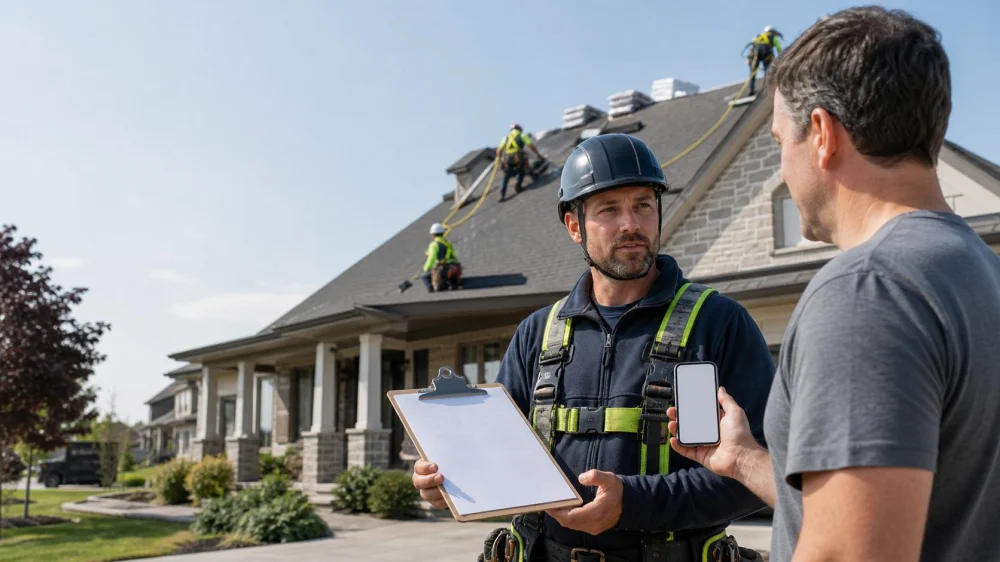
Roofing Contractor Coverage: Verify Insurance and WSIB Status
On this page
Quick answer
Before roofing work begins, verify the contractor’s commercial general liability insurance and ask the WSIB about the company’s coverage or exemption status. Obtain current documents from reliable sources, confirm that the legal business name matches the quote and contract, and check the policy dates, limits, covered operations, and subcontractor arrangements. Do not treat a logo, old certificate, or verbal promise as proof. Put responsibility for insurance, workers, property damage, and changes in a written Ontario contract.

Separate two types of coverage
Liability insurance and Workplace Safety and Insurance Board coverage address different risks. A commercial general liability policy may respond to covered third-party bodily injury or property damage, subject to its wording, limits, exclusions, and conditions. WSIB coverage relates to workplace injury and illness under Ontario’s system.
One document does not replace the other. A business can carry liability insurance while its WSIB position requires a separate check. The exact WSIB rules can depend on the business structure, workers, subcontracting, and whether work qualifies as exempt home renovation work.
Ask precise questions rather than “Are you insured?” A useful answer identifies the insurer or official body, policy or account status, legal entity, effective dates, and who will actually perform the roof work.

Custom Contracting Burlington Roofing & Eavestrough Repair Burlington / eavestrough burlington
BurlingtonRegional Municipality of HaltonOntario
687 Waterloo St, Burlington, ON L7R 2S9, Canada
Verify commercial liability insurance
Ask for a current certificate of insurance showing the contractor’s legal name, insurer, policy period, and liability limits. Confirm that roofing operations are within the described business activities and that the policy will remain active through the expected project dates.
A certificate is evidence, not the policy itself and not a promise that every event is covered. With the contractor’s permission, contact the broker or insurer using independently verified contact details to confirm that the document is genuine and current. Ask what happens if work is delayed past the expiry date.
Discuss possible damage to siding, eaves, windows, landscaping, driveways, interiors, neighbours’ property, and vehicles. The written contract should assign responsibility; an insurance claim should not be the first time the parties discuss it.
Confirm WSIB status
Ontario consumer guidance says construction workers and independent operators generally require workplace safety and insurance coverage, with exceptions, and directs consumers to WSIB to check. Ask the contractor for its legal business name and WSIB account information, then verify through WSIB rather than relying only on a screenshot.
WSIB issues clearances to show that a contractor is registered and in good standing when a clearance is required. WSIB policy also describes an exemption for householders who occupy or will occupy a private residence and directly hire a contractor only for qualifying exempt home renovation work. Because the details matter, ask WSIB how the rule applies to your project and the contractor’s structure.
If a clearance applies, check its validity period and make sure the correct contractor is named. If the contractor claims an exemption, ask for a clear explanation and verify it with WSIB before work starts.
Check the business and crews
Match the quote, insurance certificate, WSIB information, invoice, and contract to the same legal business. A trade name may differ from the registered corporation or proprietor, so document the connection.
Ask whether employees, subcontractors, or both will perform the work. Identify each subcontracted trade, who pays it, and who verifies its insurance and WSIB status. Ontario’s renovation guidance recommends that contracts list sub-trades and payment responsibility.
Confirm the workers have legally required training for their tasks, including working-at-heights requirements where applicable. Homeowners should stay off the roof and should not supply improvised fall-protection equipment.
Put the details in the contract
Ontario states that home renovation contracts worth more than $50 must be in writing. The contract should include the contractor’s identity and contact details, project description, materials, price and taxes, payment schedule, dates, warranties, subcontractors, cleanup, and responsibility for property damage.
Add the agreed insurance limit, the obligation to keep coverage current, the process for providing updated proof, and a requirement to notify you of cancellation or material change. Attach the final estimate and scope rather than leaving them in a separate email chain.
Use signed change orders for new work, new materials, or revised prices. Do not allow a coverage discussion to distract from permits, manufacturer requirements, roof access, disposal, ventilation, flashing, deck repairs, and final inspection.
Watch for warning signs
- The business name changes between the quote, certificate, and payment request.
- The certificate is expired, cropped, altered, or missing insurer details.
- The contractor refuses verification or says insurance can be purchased after a loss.
- No one can explain who employs or supervises the crew.
- A large cash deposit is demanded before documents or a detailed scope are supplied.
- The contractor pressures you to sign immediately or discourages independent checks.
Pause the project when documents do not align. Get clarification in writing and compare another qualified roofer.
Limitations and important notes
This guide is general consumer information, not legal or insurance advice. Coverage depends on the actual policy, facts of a loss, contract, and current law. WSIB status and exemptions are fact-specific.
For a complex, high-value, commercial, rental, or multi-residential project, consult an Ontario lawyer and appropriate insurance professionals before signing.
Sources and evidence notes
The Ontario and WSIB pages below describe consumer contract expectations and the construction clearance framework. Check their current versions at the time of hiring.
- Government of Ontario: Hiring a Roofer
- Government of Ontario: Home Renovation and Repair Rights
- WSIB: Clearance Certificate in Construction
Frequently asked questions
Is a certificate of insurance enough?
It is useful evidence, but verify that it is genuine, current, matches the legal business, and reflects the relevant operations and project period.
Does every homeowner need a WSIB clearance?
Not necessarily. WSIB policy describes an exemption for certain occupied private-residence renovation arrangements. Ask WSIB how the rules apply to the exact project.
What if the roofer uses subcontractors?
Identify them in the contract and confirm who verifies their insurance, WSIB position, supervision, and payment.
Should the lowest insured quote win?
No. Coverage is one screening factor. Compare scope, materials, workmanship, schedule, warranties, references, cleanup, and total price.
Can documents be checked after work starts?
Do the checks before access, delivery, or work. Recheck any document that expires before completion.
Next steps
Create a one-page verification record for each bidder: legal name, contact details, insurer, policy dates and limits, WSIB status or confirmed exemption, subcontractors, and source of verification. Resolve mismatches before selecting a roofer. Attach the chosen estimate and document requirements to the written contract, then calendar any expiry date that falls near the project schedule.


 Rydel Roofing in Ottawa4.0 (123 reviews)
 CentiMark Ltd.0.0 (0 reviews)
 Shumba Roofing Solutions4.0 (3 reviews)
 Rydel Roofing & Siding4.0 (55 reviews)
 Expert Roofing5.0 (18 reviews)
 SH Roofing Aluminum4.0 (8 reviews)
 How Much Does a New Roof Cost in 2025? Canadian Roofing Price Guide
 Top Signs Your Roof Has a Leak and What to Do About It in Canada
 Can You Install a New Roof Over an Old One in Canada?
 The Top Questions to Ask Before Hiring a Roofer in Canada
 What Are the Most Common Roofing Scams and How to Avoid Them in Canada
 How to Prepare Your Home for a Roofing Project in Canada