
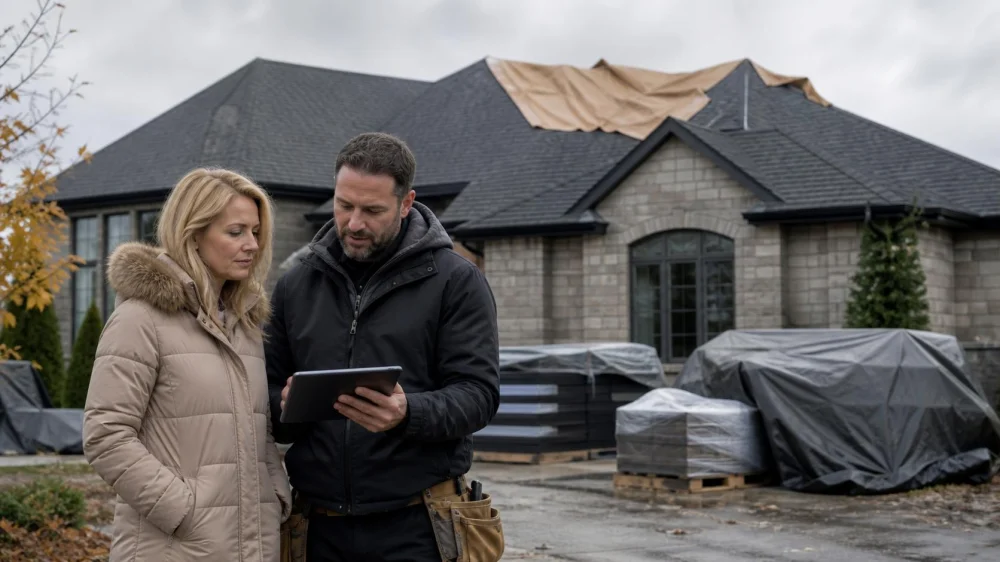
Roofing Weather Delay Plan: Protect the Home and Schedule
On this page
Quick answer
Before roofing starts, agree who monitors weather, who decides to stop, how much roof may be opened, and how the contractor makes the home watertight at every day's end. Define material storage, emergency tarping, interior leak response, site security, notifications, schedule changes, and added-cost approval. Ask for photos of daily dry-in and never climb onto a wet, icy, windy, or unfinished roof to inspect it yourself.

CentiMark Ltd. / centimark corporation
740 Huronia Rd Unit 9, Barrie, ON L4N 6C6, Canada
Define weather decisions
A roofing weather delay plan states how the contractor protects the building, people, materials, and schedule when conditions prevent normal work. Rain is not the only trigger; wind, lightning, heat, cold, frost, ice, snow, smoke, and poor visibility can affect products and worker safety.
Ask which forecast source and site observations guide decisions, who has stop-work authority, and when the homeowner receives notice. Product temperature and moisture limits should follow manufacturer instructions, not a general calendar date.

Custom Contracting Burlington Roofing & Eavestrough Repair Burlington / eavestrough burlington
BurlingtonRegional Municipality of HaltonOntario
687 Waterloo St, Burlington, ON L7R 2S9, Canada
Plan daily dry-in
Confirm how much roofing will be removed at once, what temporary underlayment or covering is used, how penetrations and edges are sealed, and how unfinished valleys, skylights, chimneys, vents, and wall intersections are protected.
Ask for an end-of-day check from the ground and inside accessible attic areas, plus dated photos from qualified workers. Define the emergency number and response if water enters overnight. Do not treat a loose tarp as completed waterproofing.
Protect materials and property
Agree where shingles, membranes, insulation, fasteners, adhesives, tools, waste containers, and lifts are stored. Materials should follow manufacturer requirements for cover, ventilation, stacking, temperature, and moisture. Loose items must be secured for wind.
Keep drainage, downspouts, doors, walkways, fire access, and neighbouring property clear. Protect open landscaping and interior belongings from runoff. If a delay extends, ask who rechecks temporary protection and how often.
Set communication rules
Name one contractor contact and one owner decision-maker. Daily updates should state work completed, roof areas protected, weather outlook, next decision time, revised schedule, and any new damage or cost.
Separate ordinary weather delay included in the contract from added work caused by concealed damage, emergency protection, or owner changes. Require a written change describing scope, price, and schedule before nonurgent added work.
Delay-plan checklist
- Forecast source and stop-work authority.
- Maximum open area and daily dry-in method.
- Temporary protection for penetrations and edges.
- Material and debris security.
- Interior leak and emergency contact process.
- Daily photos and update time.
- Schedule and change-order rules.
- Post-delay inspection before work resumes.
Limitations and notes
This guide cannot determine safe roofing conditions or code compliance. Follow current Ontario occupational-safety requirements, Pickering permits, manufacturer instructions, and the written contract. Homeowners should inspect from safe ground or interior locations, not access the roof.
FAQ
Can roofers work in light rain?
The contractor must decide based on worker safety, roof system, materials, and manufacturer limits; do not assume.
Who pays for weather delays?
The contract and cause of added work matter. Ask for defined delay and change terms.
Should materials stay on the roof overnight?
Only when stored and secured according to contractor safety and manufacturer requirements.
What if water enters?
Protect people, avoid electrical hazards, contact the contractor's emergency process, document from a safe location, and escalate severe hazards appropriately.
Evidence notes
This guide reflects common construction-risk practice: weather criteria, limited exposure, daily dry-in, secured materials, documented inspections, emergency response, and written changes. It does not guarantee a weatherproof project.
Next steps
Add a one-page weather plan to the pre-start meeting. Record contacts, daily cutoff, photo delivery, temporary protection, and the exact point when a schedule or cost change needs written approval.




 Accell Roofing Inc4.0 (57 reviews)
 Outstanding roofing4.0 (69 reviews)
 Boucher’s Roofing5.0 (4 reviews)
 Kion Construction5.0 (6 reviews)
 Toitures Montcalm5.0 (1 reviews)
 Roof Pro Plus Home Improvements3.0 (7 reviews)
 How Much Does a New Roof Cost in 2025? Canadian Roofing Price Guide
 Top Signs Your Roof Has a Leak and What to Do About It in Canada
 Can You Install a New Roof Over an Old One in Canada?
 The Top Questions to Ask Before Hiring a Roofer in Canada
 What Are the Most Common Roofing Scams and How to Avoid Them in Canada
 How to Prepare Your Home for a Roofing Project in Canada