
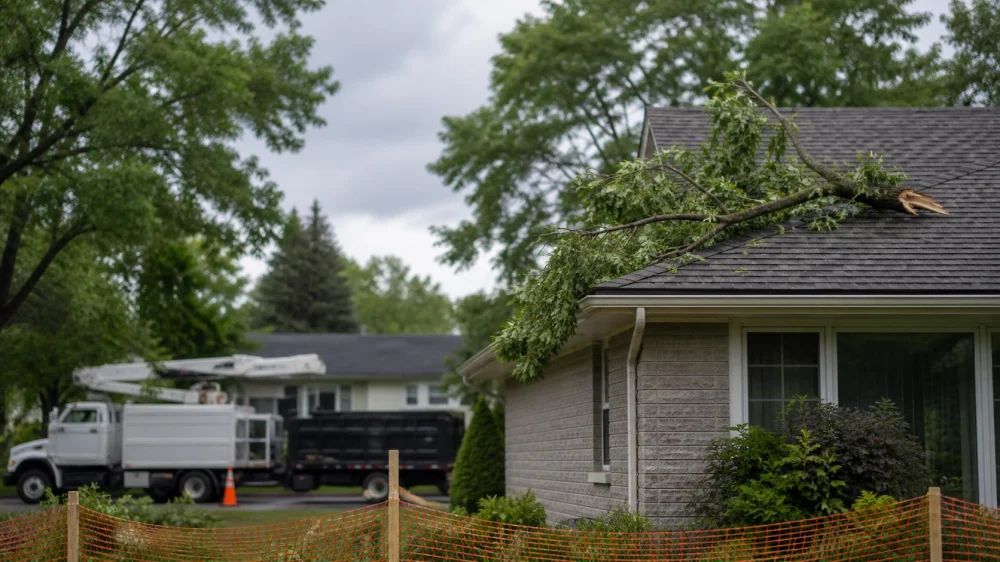
Tree Limb on the Roof: Keep Clear and Call the Right Help
On this page
Quick answer
If a tree limb lands on a roof, keep everyone away from the tree, roof edge, damaged rooms, and any electrical lines. Do not climb, cut, pull, or move the limb. Call 911 for fire, collapse, injury, gas smell, or immediate danger; call the utility for any line involvement; then contact an insured arborist, roofing contractor, and insurer as appropriate.
A limb can shift without warning and may hide punctures, broken framing, unstable masonry, or energised conductors. Photograph only from a safe ground position after the danger area is established.
Immediate danger signs
- downed or sagging electrical lines, sparks, or buzzing;
- roof, ceiling, wall, chimney, or porch movement;
- gas odour, hissing, fire, or smoke;
- water entering electrical fixtures or the service panel;
- a split trunk or suspended branch still moving; or
- blocked exits or injured occupants.
Treat every downed line as energised. Stay far away from the line and anything it touches, including branches, fences, puddles, and vehicles. Follow utility and emergency-service instructions.
CentiMark Ltd. / centimark corporation
740 Huronia Rd Unit 9, Barrie, ON L4N 6C6, Canada
Set a safe boundary
Move people and pets to the opposite side of the property or another safe location. Block doors and walkways beneath the limb. Do not park vehicles where branches, roofing, or tools may fall.
Wind, rain, snow, and tree tension can change the scene. A branch stable for an hour may move during inspection or cutting. Only trained professionals should establish work zones.
Document from the ground
Take wide photographs of the whole tree and building, then zoom images of the contact point, roof plane, gutters, chimney, siding, windows, and debris. Photograph interior stains, cracks, or fallen material without entering a damaged room.
Record storm time, noises, visible changes, calls, and temporary instructions. Preserve original files and receipts. Do not delay emergency calls for photos.
Call in the right order
- Emergency services for life, fire, gas, or collapse danger.
- The electrical utility for lines or electrical service involvement.
- The property insurer for claim and mitigation instructions.
- An insured certified arborist for tree stabilisation and removal.
- An insured roofing contractor for weatherproofing and repair.
- A structural professional when framing or major movement is suspected.
Coordinate the arborist and roofer. Removing weight can reveal damage or destabilise the remaining tree; roofing work cannot begin safely beneath an uncontrolled limb.
What professionals should inspect
The arborist should assess the whole tree, not only the fallen section. The roofer should examine shingles or membrane, decking, flashings, vents, gutters, fascia, soffit, chimney contact, and interior leakage. Structural assessment may be needed for rafters, trusses, walls, and ceiling movement.
Request written scope, photos, emergency stabilisation, cleanup, and warranty information. Verify insurance and required worker coverage before authorising non-emergency work.
Temporary protection limits
Do not climb to install a tarp. Roofs may be wet, punctured, or structurally weak. A qualified contractor can select anchoring that does not create more damage and can protect openings without trapping water.
Indoors, place containers under drips only in a structurally safe, electrically clear area. Do not touch wet fixtures, sagging ceilings, or broken insulation. Move valuables only when officials say the room is safe.
Storm response checklist
- Stay away from the limb, tree, roof edge, and lines.
- Call emergency services and utility when indicated.
- Move occupants from damaged rooms.
- Photograph only from safe ground.
- Notify insurer before major non-emergency work.
- Coordinate insured arborist and roofer.
- Do not climb, cut, pull, or tarp the roof yourself.
Frequently asked questions
Can I cut a small branch?
Not while it rests on the roof or may be under tension. Ask an arborist.
What if no damage is visible?
Hidden punctures, cracked decking, or flashing damage still need inspection.
Should I call a roofer or arborist first?
Control the tree hazard first while coordinating both trades; utilities and emergency services take priority.
Can I put up a tarp?
Do not climb a damaged roof. Use qualified emergency mitigation.
What if a line touches the tree?
Stay away from the entire tree and call the utility and emergency services.
Should I remove indoor debris?
Only after the area is declared structurally and electrically safe.
Sources and evidence notes
CCOHS identifies weak roofs, falling objects, improper ladder use, slippery surfaces, and weather as serious roofing hazards. See CCOHS residential roofing safety.
Utility and emergency-service instructions control any scene involving downed lines, gas, fire, or collapse. Treat lines as live and do not approach anything they touch.
Conclusion and next steps
Keep clear of a limb on the roof and treat line, gas, fire, and collapse signs as emergencies. Document only from safe ground, notify the insurer, and coordinate an insured arborist and roofing contractor. Do not climb, cut, pull, or tarp until the tree and structure are professionally controlled.

 JXN ROOFING5.0 (1 reviews)
 Hamati Roofing Ltd.5.0 (10 reviews)
 Abby Roofing - Roofing Orléans0.0 (0 reviews)
 DB Roofing5.0 (4 reviews)
 iRoofing5.0 (1 reviews)
 NP Roofing3.0 (5 reviews)
 How Much Does a New Roof Cost in 2025? Canadian Roofing Price Guide
 Top Signs Your Roof Has a Leak and What to Do About It in Canada
 Can You Install a New Roof Over an Old One in Canada?
 The Top Questions to Ask Before Hiring a Roofer in Canada
 What Are the Most Common Roofing Scams and How to Avoid Them in Canada
 How to Prepare Your Home for a Roofing Project in Canada