
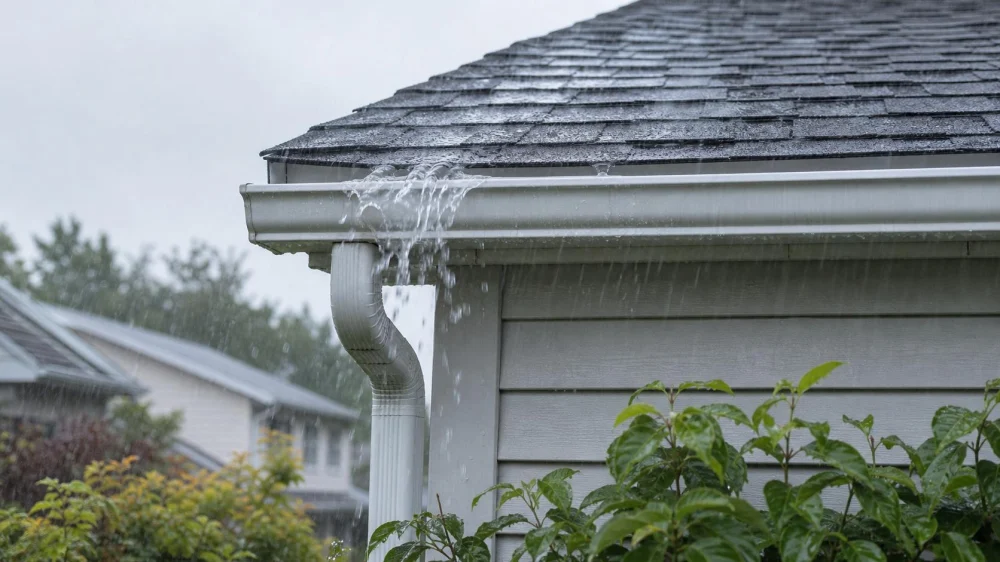
Why Gutters Overflow During Rain and What to Check Safely
On this page
- Quick answer
- What gutter overflow means
- Common causes of overflowing gutters
- What to observe during rain
- Ground-level checks after the storm
- Protect the property without unsafe roof work
- When to call a roofing or gutter professional
- Limitations and evidence notes
- Frequently asked questions
- Conclusion and next steps
Quick answer
Gutters overflow when rainwater reaches them faster than the system can collect and discharge it. Common reasons include leaf debris, a blocked downspout, poor slope, loose sections, undersized drainage, ice, or water missing the gutter edge. Observe from a dry window or the ground, document where overflow begins, keep away from ladders and electrical hazards, and arrange professional inspection when the cause is not safely accessible.

Flynn Canada Ltd. - Toronto / flynn mississauga
MississaugaRegional Municipality of PeelOntario
6435 Northwest Dr, Mississauga, ON L4V 1X1, Canada
What gutter overflow means
A roof gutter is a channel at the eave that collects runoff and directs it through downspouts to an approved discharge point. Overflow is visible water passing over, behind, or beyond that intended path.
The location and timing provide useful clues:
- Overflow near a downspout: The outlet, downspout, elbow, or connected drain may be restricted.
- Overflow in the middle of a run: Debris, poor slope, sagging, a low spot, or limited capacity may be involved.
- Water behind the gutter: Loose fastening, eave damage, missing edge details, or water bypassing the gutter may need inspection.
- Water shooting past the gutter: A steep roof, concentrated valley flow, misalignment, or unusually intense rain may exceed the collection point.
Overflow is a symptom, not a complete diagnosis. Several causes can exist at the same time.
Vancouver Moss Removal / moss removal near me
VancouverMetro VancouverBritish Columbia
1615 Frances St #105, Vancouver, BC V5L 1Z3, Canada
Common causes of overflowing gutters
- Leaves and organic debris: Material can reduce the channel depth, cover the outlet, and form a dense mat.
- Blocked downspout: Debris, ice, a crushed section, displaced elbow, or animal nesting can stop flow below the visible gutter.
- Incorrect slope or sagging: Water may collect in a low area instead of moving toward the outlet.
- Loose or deformed gutter: Fasteners can pull away, seams can separate, and snow or ice can change alignment.
- Insufficient capacity: Roof area, pitch, valley concentration, outlet count, gutter profile, and rainfall intensity all affect required capacity.
- Roof-edge problem: Runoff may travel behind the gutter or miss it because of installation details, damaged fascia, or eave conditions.
- Restricted underground discharge: A clear downspout can still back up if the buried drain or outlet is blocked, frozen, or submerged.
- Winter obstruction: Snow and ice can block channels and outlets. Ice-dam conditions require a separate roof and attic assessment.
What to observe during rain
Stay indoors or under safe shelter. Do not walk beneath roof edges in heavy rain, wind, lightning, falling ice, or when branches and roofing materials may fall.
- Note the time rain starts and when overflow becomes visible.
- Record the exact section: corner, valley, middle, end cap, or downspout.
- Watch whether water goes over the front, behind the gutter, or past it from the roof.
- Look at the downspout outlet from a safe distance. Strong roof runoff with little outlet flow suggests a restriction, but does not prove its location.
- Check inside for new staining, dripping, damp odour, bubbling paint, or water near windows and electrical fixtures.
- Take photos or video from a safe, stable position for the contractor.
Never climb a ladder during rain or stand on wet roofing. Keep extension poles away from overhead electrical lines. Do not open a downspout cleanout while water is backed up unless the system has a safe, manufacturer-approved service method.
Ground-level checks after the storm
- Wait for safe conditions. Avoid lightning, high wind, ice, deep water, and unstable ground.
- Walk the perimeter from a distance. Look for sagging lines, separated joints, detached downspouts, bent sections, and debris visible at outlets.
- Inspect the ground. Note erosion, mulch displacement, soil splash, standing water, or foundation-adjacent wet areas below the overflow.
- Check discharge direction. Confirm extensions remain connected and direct water only to an approved location away from the building, neighbouring property, walkways, and unsafe ice zones.
- Look for eave clues. Peeling paint, dark fascia marks, staining under soffits, and softened wood can indicate repeated wetting.
- Document interior changes. Photograph ceiling or wall stains and mark their edges lightly with date and time if appropriate.
- Compare patterns. Note whether overflow occurs in every rain or only during intense rain, snowmelt, freeze-thaw, or wind-driven storms.
Binoculars or a camera zoom can help with observation, but cannot confirm hidden fastening, membrane, flashing, or wood condition.
Protect the property without unsafe roof work
Keep people away from slippery walkways and falling-water zones. Move portable belongings from an interior leak area only when it is safe, and place a container under a drip without touching wet electrical fixtures or swollen ceilings.
Do not redirect water onto a public path, neighbouring property, septic area, unstable slope, or foundation. In freezing weather, redirected water can create dangerous ice. Follow local drainage requirements and ask a professional where discharge is permitted.
A homeowner may clear loose material at a ground-level outlet if it is fully accessible, conditions are safe, and no tool approaches electricity. Stop if water is pressurized behind debris, the pipe is damaged, the outlet is frozen, or access requires climbing or excavation.
Avoid drilling holes, forcing rods through elbows, pressure-washing from below, fastening sagging gutters, or chipping ice. These actions can damage the system, eave, roofing, underground line, or nearby utilities.
When to call a roofing or gutter professional
Arrange inspection when overflow repeats, water travels behind the gutter, sections sag or detach, seams leak, fascia or soffits are damaged, a downspout remains blocked, or drainage near the foundation cannot be corrected from an accessible outlet.
A roofing professional is especially useful when runoff bypasses the gutter at a valley or roof edge, shingles or metal are damaged, interior leakage appears, or the eave assembly may be involved. A gutter specialist can assess slope, supports, outlets, capacity, and downspouts. A drainage professional may be needed for underground leaders, grading, and discharge.
Seek urgent help for an active electrical hazard, rapidly expanding ceiling bulge, falling gutter, major interior water entry, structural movement, or unsafe ice accumulation. Keep the area isolated while following emergency guidance.
Limitations and evidence notes
This guidance reflects common roof-drainage practice for Canadian homes. Correct gutter and downspout design depends on roof geometry, local rainfall, snow and ice conditions, building details, discharge rules, and product requirements. A ground observation cannot calculate capacity or verify hidden installation.
Building and drainage requirements vary across Canada by province, municipality, property type, and project scope. Follow current local requirements and manufacturer instructions. General advice cannot determine responsibility for a shared, strata, condominium, rental, or boundary drainage system.
Frequently asked questions
Can clean gutters still overflow?
Yes. Poor slope, too few outlets, an undersized system, a blocked underground drain, roof-valley concentration, misalignment, or unusually intense rain can cause overflow without visible leaves.
Why does water run behind the gutter?
The gutter may be loose, the eave or roof-edge detail may be directing water incorrectly, or fascia and roofing components may be damaged. This pattern deserves professional inspection because hidden wood can stay wet.
Do gutter guards prevent all overflow?
No. Guards can reduce certain debris but may shed water, collect fine material, become blocked, or require maintenance. Their performance depends on design, installation, roof conditions, and rain intensity.
Should I climb up and clear the gutter after rain?
Not while surfaces are wet or conditions are unstable. Ladder and roof work carries fall risk and may require trained, insured service. Use ground observations to document the problem and hire appropriate help.
Can overflowing gutters damage a foundation?
Repeated concentrated water near a building can contribute to erosion, wet basements, and moisture problems, but the outcome depends on grading, soils, drainage, waterproofing, and foundation design. Correct the source and have persistent moisture assessed.
Conclusion and next steps
Observe where and how the gutter overflows, document outlet flow and interior effects, then inspect only from safe ground after conditions improve. Keep people away from slip and electrical hazards. Repeated overflow, water behind the gutter, sagging, ice, or hidden drainage problems require professional diagnosis of the entire path from roof edge to final discharge.



 Nor Star Aluminum & Vinyl Products4.0 (42 reviews)
 Water Tight Roofing & Masonry5.0 (10 reviews)
 JOHNSON ROOFING AND REPAIR4.0 (4 reviews)
 United Roofing3.0 (15 reviews)
 Les Entreprises B&C S.E.N.C0.0 (0 reviews)
 Dillon Bros. Roofing4.0 (11 reviews)
 How Much Does a New Roof Cost in 2025? Canadian Roofing Price Guide
 Top Signs Your Roof Has a Leak and What to Do About It in Canada
 Can You Install a New Roof Over an Old One in Canada?
 The Top Questions to Ask Before Hiring a Roofer in Canada
 What Are the Most Common Roofing Scams and How to Avoid Them in Canada
 How to Prepare Your Home for a Roofing Project in Canada